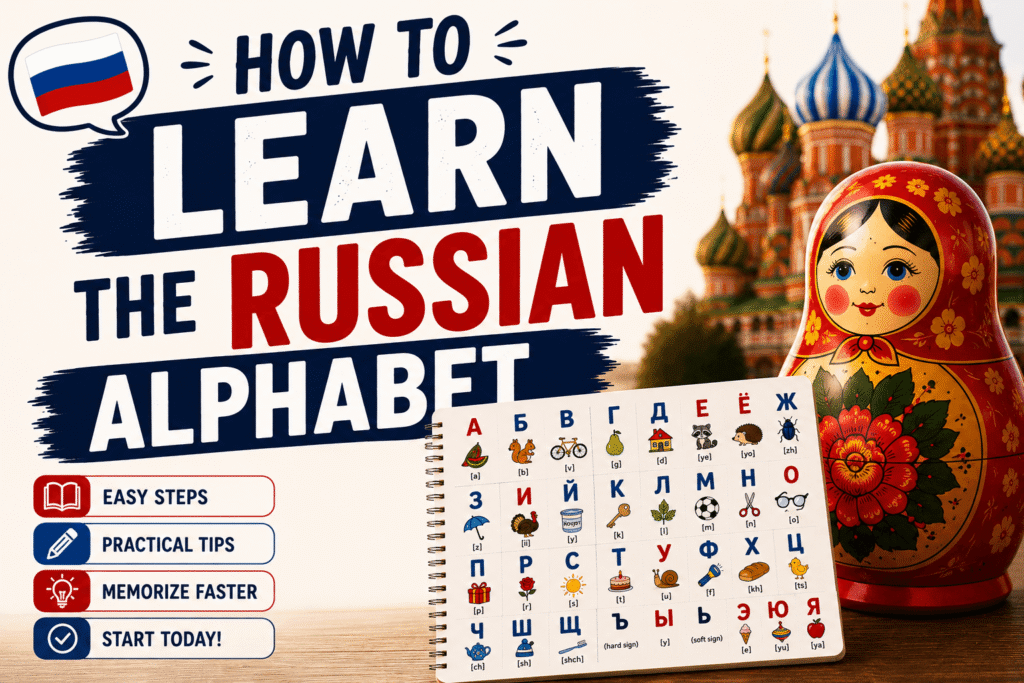
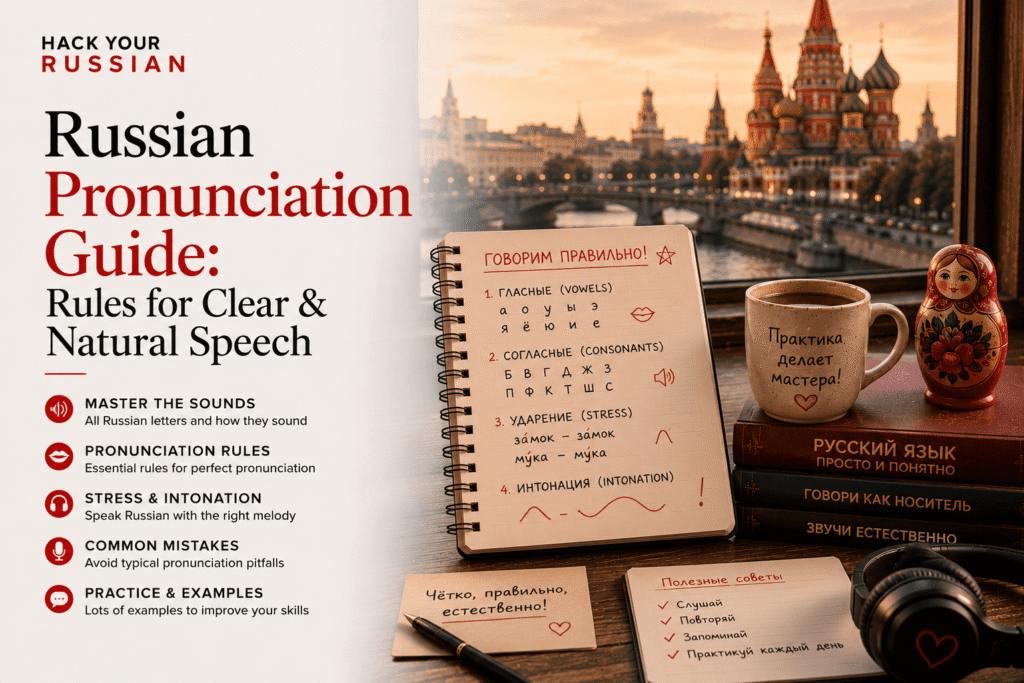
So, why is it actually important to speak Russian with correct pronunciation? And I’m not talking about your accent — having an accent is completely fine. The issue is mispronouncing words, which can lead to misunderstandings with native speakers. Many learners believe pronunciation isn’t that important, and to some extent, that’s true. Russian people are usually patient and will try to understand you, even if you speak slowly or make small pronunciation mistakes.
However, there are several advantages to speaking with accurate Russian pronunciation:
- Confidence: You’ll feel more confident speaking Russian because you’ll be proud of your pronunciation.
- Avoid misunderstandings: You’ll prevent awkward situations where a mispronounced word could change the meaning of what you intended to say.
- Positive impression: Russian people will admire your pronunciation. While they’re happy when foreigners speak their language, it can be a bit funny to hear obvious mispronunciations. Correct pronunciation makes communication smoother and more pleasant.
- Better listening skills: Accurate pronunciation helps you understand fast, natural speech. If your own pronunciation patterns are incorrect, it becomes harder to recognize words as they are actually spoken.
And if you think it’s impossible for a foreigner to master proper Russian pronunciation, I’m here to tell you it’s entirely possible. Russian has consistent pronunciation rules. Yes, it takes time and practice, but learning them is far better than constantly wondering why some words in Russian aren’t pronounced the way they’re written.
Table of Contents
Why Russian Pronunciation Feels Difficult at First
Russian pronunciation can feel confusing for beginners because Russian words are not always pronounced exactly the way they are written. The main reason is stress. In Russian, one syllable in a word is stressed, and the vowels in unstressed syllables often become weaker or change their sound.
For example, the letter О is written in words like молоко́, хорошо́, and Москва́, but not every О is pronounced like a clear О. When О is unstressed, it is usually pronounced closer to А.
That is why learning Russian pronunciation is not only about memorizing letters. You also need to learn:
- where the stress falls in a word;
- how unstressed vowels change;
- how hard and soft consonants work;
- when Е, Ё, Ю, Я have a “й” sound;
- how Russian words sound in connected speech.
The good news is that Russian pronunciation is quite logical once you understand the main rules. You do not need to sound exactly like a native speaker, but clear pronunciation will help you speak with more confidence and understand native speakers more easily.
If you are still learning Cyrillic, start with my complete guide to the Russian alphabet before studying pronunciation rules.
Key tips to improve your pronunciation in Russian
Always Learn Russian Words with Stress
The first pronunciation rule every Russian learner should remember is simple: always learn new words with stress.
Russian stress is unpredictable. It can fall on the first syllable, middle syllable, or last syllable. Sometimes stress even changes between different forms of the same word. Stress can even change the meaning of a word, just like in other Russian words with several meanings.
For example:
за́мок
castle
замо́к
lock
The spelling is the same, but the stress changes the meaning.
Stress is also important because it affects vowel pronunciation. If a vowel is stressed, it is pronounced clearly. If it is unstressed, it may become weaker or change its sound.
Compare:
во́ды
waters
воды́
of water
In the first word, О is stressed and pronounced clearly. In the second word, О is unstressed and sounds closer to А.
So, when you learn a new Russian word, do not only write the translation. Write the stress too:
хорошо́
молоко́
краси́вый
спаси́бо
пожа́луйста
This one habit will improve your Russian pronunciation more than memorizing random pronunciation tricks.
Naughty Russian Vowels
If you want to speak with a proper Russian pronunciation, you need to know about naughty Russian vowels: these are the vowels that are not pronounced the same way as they are written IF they are unstressed. That is why learning Russian words with a correct stress is also very important. So, if unstressed some Russian vowels will be pronounced less strong or completely differently. The ones that can be pronounced completely different are the vowels: Е, О, Э, Я.

Well, you probably already know about a vowel О. In all, really ALL cases when a vowel О is not stressed in a word, it should be pronounced as А. Хорошо, молодец, молоко, холодно.
More examples:
окно́ [акнО] – a window
Москва́ [МасквА] – Moscow
молоде́ц [малад′Эц] – achiever
пого́да [пагОда] – weather
у́тро [Утра] – morning
ско́лько [скОл′ка] – how much / many
отли́чно [атл′Ична] – excellent
хо́лодно [хОладна] – cold
It’s also very important to note that if you have a word with a preposition that contains a letter О, you will pronounce it as А because prepositions are not stressed but we read them together with a word that comes after. For example in a word ‘до свидания’. It will not sound natural.
More examples:
от кого́ [аткавО], по по́чте [папОчт’э], про тебя́ [прат’иб’А], о не́й [ан’Эй],
обо мне́ [абамн’Э], об Оле́ге [абал’Эг’э].
More Examples of Unstressed О in Russian
One of the most important Russian pronunciation rules is that unstressed О usually sounds like А. This is called vowel reduction.
Here are more examples:
| Written Russian | Pronunciation hint | Meaning |
|---|---|---|
| молоко́ | малако́ | milk |
| хорошо́ | харашо́ | good / well |
| дорого́й | дараго́й | expensive / dear |
| говори́ть | гавари́ть | to speak |
| помоги́ | памаги́ | help me |
| потому́ что | патаму́ шта | because |
| соба́ка | саба́ка | dog |
| вода́ | вада́ | water |
This does not mean that you should pronounce every О as a strong А. In natural Russian, unstressed vowels are usually shorter and weaker than stressed vowels. The most important thing is not to pronounce unstressed О like a clear English “o”.
For example, молоко́ should not sound like “mo-lo-ko”. A more natural pronunciation is closer to малако́.
You have also probably noticed that a vowel Е when unstressed is pronounced as И. There are also some situations when unstressed Е is pronounced as ЙИ. But in some cases an unstressed Е is better to pronounce as Е or Э with a softened consonant. Don’t worry, it is easy!
Let’s look at these words:
Лес [л’эс] – леса [лисА]
Лето [л’Эта] – летать [литАт’]
Евро [йЭвра] – Европа [йиврОпа]
But if you have an unstressed Е in the end of words, you will notice that it should be pronounce as a very short Е or Э with a softened consonant.
Like, in в Америке [вам’Эрик’э].
Transcription in Latin
The next important thing that you need to know if you want to sound more natural in Russian is that you have to stop relying on the transcription of words in Latin. First of all, it’s not a transcription, it’s a transliteration – which is a way to represent how each letter sound separately, but not in word. Latin letters cannot show you how to pronounce Russian letters. Period! It only makes it worth. Yes, there is an International phonetic alphabet which I don’t really like and I never use simply because I don’t trust anything International. Russian sounds are completely different from English sounds and therefore you need to use transcription in Cyrillic not in Latin. Let’s admit, when you start learning Russian language, the first thing you do is to learn Russian alphabet. Right? You learn how to pronounce each letter so you can perfectly use a transcription in Cyrillic. So, when you learn a new word but it’s not pronounced the same as it’s written – you can write its transcription yourself in Cyrillic. This is the way Russian people do as well when we are at school. We learn letters and sounds. And believe me, it’s not only easy, it also can be fun to analyze how to pronounce each word even before hearing how to pronounce it correctly.
Latin transliteration can be useful for finding a Russian word online, but it is not a reliable pronunciation guide. The problem is that Latin letters cannot show important Russian pronunciation features.
For example, transliteration often does not show:
- Russian stress;
- vowel reduction;
- hard and soft consonants;
- the difference between ы and и;
- the real pronunciation of Е, Ё, Ю, Я after consonants;
- connected speech.
Look at this example:
тебя́
A beginner may see a Latin version like tebya and pronounce it with a strong “ye” sound after б. But in Russian, б becomes soft and я does not sound like a separate “ya” after the consonant. A more useful Cyrillic pronunciation hint is:
тебя́ → тибя́
Another example:
люблю́
Latin transliteration may make learners pronounce it like lyublyu, but the real Russian pronunciation depends on soft consonants, not English-style “yu” sounds.
This is why it is much better to learn Cyrillic well and write pronunciation hints in Cyrillic. Russian learners who depend too much on Latin letters often keep an accent that is harder to correct later.
Consonants Ж, Ш and Ц Are Always Hard
Some Russian consonants are always hard. The most important ones are:
Ж, Ш, Ц
This means that even when they are followed by letters that usually show softness, they stay hard.
For example:
жить
to live
шить
to sew
цирк
circus
The spelling may look as if the consonant should become soft, but Ж, Ш, Ц remain hard.
This is also important for pronunciation of unstressed vowels. After Ж and Ш, an unstressed Е may sound closer to Ы in real pronunciation.
For example:
жена́
wife
pronunciation: жына́
желать
to wish
pronunciation: жыла́ть
шепта́ть
to whisper
pronunciation: шыпта́ть
This is one of the reasons why Russian pronunciation cannot be learned only through Latin transliteration. You need to understand how Russian letters and sounds interact.
To understand softness better, read my guide to Russian hard and soft signs.
Tricky Russian Vowels
And here comes one of the main reasons why Latin transcription for Russian words…sucks…
There are some tricky vowels in Russian language that make foreigners who learn Russian language sound…funny. Really, I have already seen even some advanced learners who made this mistake. So, these tricky vowels are Е, Ё, Ю, Я. I’ve already mentioned them in my video on a Russian hard sign.
So, these 4 letters are very tricky. They are letters and not sounds, which is very important. Separately, each of them make up two sounds.

The problem arises from here because some learners believe that these letters are pronounced this way everywhere. And this is a fault of Latin transcription of Russian words.
Just look at this table. As you can see the pronunciation of these vowels depend a lot on its position in a word. After vowels, after a soft and a hard sign, as well as in the beginning of words, these vowels will be pronounced as a combination of two sounds, where the key element is a sound Й.
BUT! After consonants they should be pronounced without a sound Й. And it’s a very common mistake of Russian language learners, when they pronounce Меня, люблю, тебе and so on.

And it’s not their fault! It’s a fault of Latin transcription, because in the majority of Russian textbooks with a Latin transcription you will find this sound Y where it should and where it shouldn’t be. Because again, it’s not a transcription but a transliteration – the representation of each letter separately.
So, look at this phrase
Жела́ю тебе́ сча́стья! [жылАй’у тиб’Э щАст’йа]
Let’s analyse. First, желаю. Well, here we have a mix of rules actually. Normally this е should be pronounced as и because it is not stressed, BUT it comes after a consonant Ж which is always hard and it also turns this и into a hard ы. A letter Ю is pronounced as a combination of Й+У because it comes after a vowel. Тебе́ – the first Е is not stressed and pronounced as И, but the second one is stressed and comes after as consonant so it should be pronounced as Э with a softened consonant Б. And the last word – счастья, сч is pronounced as щ (and it’s another rule that concerns consonants) and then we have a vowel Я that comes after a soft sign and therefore it should be pronounced as a combination of two sounds. You see, it’s really that easy!
Soft Consonants Are Essential in Russian
Russian has hard and soft consonants. This is one of the biggest differences between Russian and English pronunciation.
A soft consonant is not just a consonant with a small “y” after it. It is pronounced with the middle of the tongue raised toward the roof of the mouth.
Compare:
мат
mat / obscene language
мять
to crumple
брат
brother
брать
to take
угол
corner
уголь
coal
These pairs are important because softness can change the meaning of a word.
Softness is usually shown by:
- Е, Ё, И, Ю, Я after a consonant;
- the soft sign Ь.
Examples:
мел
chalk
soft м
мял
he crumpled
soft м
конь
horse
soft н
день
day
soft д and н
For many learners, soft consonants are difficult at first. But once you start hearing the difference, Russian pronunciation becomes much clearer.
Voiced Consonants Become Voiceless at the End of Words
Another important Russian pronunciation rule is final devoicing. This means that some voiced consonants become voiceless at the end of a word.
For example:
Б → П
В → Ф
Г → К
Д → Т
Ж → Ш
З → С
Examples:
| Written word | Pronunciation hint | Meaning |
|---|---|---|
| хлеб | хлеп | bread |
| друг | друк | friend |
| город | горот | city |
| глаз | глас | eye |
| нож | нош | knife |
| любовь | любофь | love |
This rule is very important because native speakers do it automatically. If you pronounce final voiced consonants too strongly, your Russian may sound unnatural.
However, the spelling does not change. You still write друг, город, хлеб, but you pronounce the final consonant as voiceless.
Some Letter Combinations Change in Speech
Russian has several letter combinations that are not pronounced letter by letter. Some combinations become easier to pronounce in natural speech.
For example:
сч → щ
сча́стье
happiness
pronunciation: ща́стье
счита́ть
to count / to think
pronunciation: щита́ть
зч / жч → щ
му́жчина
man
pronunciation: му́щина
что → што
The word что is pronounced што in standard Russian.
сего́дня → сево́дня
The word сего́дня is pronounced closer to сево́дня.
These combinations are important because they appear in very common words. If you pronounce every written letter separately, your Russian may sound unnatural and harder to understand.
If you want to understand more examples from natural speech, read my practical guide on how to speak Russian like a native.
If you want to learn more Russian pronunciation rules, you can check out my Russian Pronunciation Course, which will help you not only improve your Russian pronunciation but also to enhance your comprehension of a fast spoken speech in Russian.
If you have recently started to learn Russian language, you should absolutely have my free guide ‘Essential Russian Words and Expressions to Understand Spoken Russian’.
If you wish to speak Russian, you should absolutely learn how to use Russian cases. Check the most comprehensive guides to Russian cases:

How to Practice Russian Pronunciation
Knowing pronunciation rules is useful, but you also need to train your mouth and ears. Here is a simple practice routine.
Step 1: Learn the stress
When you learn a new word, mark the stressed syllable.
Example:
молоко́
хорошо́
краси́вый
пожа́луйста
Say the stressed vowel clearly and make the unstressed vowels shorter.
Step 2: Write Cyrillic pronunciation hints
Instead of writing Russian words in Latin letters, write pronunciation hints in Cyrillic.
Example:
молоко́ → малако́
хорошо́ → харашо́
тебя́ → тибя́
сего́дня → сево́дня
This helps you think in Russian sounds, not English letters.
Step 3: Practice minimal pairs
Choose pairs of words where one sound changes the meaning.
Examples:
мат — мять
брат — брать
лук — люк
угол — уголь
Repeat them slowly and pay attention to hard and soft consonants.
Step 4: Record yourself
Record a short Russian sentence on your phone. Then listen to it and check:
- Did I stress the correct syllable?
- Did I reduce unstressed О?
- Did I pronounce soft consonants?
- Did I pronounce final consonants correctly?
- Did I sound too “letter by letter”?
Step 5: Practice with real phrases
Do not practice only isolated words. Use full phrases:
До свида́ния.
Goodbye.
Как дела́?
How are you?
Я не понима́ю.
I don’t understand.
Жела́ю тебе́ сча́стья.
I wish you happiness.
This will help you pronounce Russian more naturally in real conversations.
Common Russian Pronunciation Mistakes
Mistake 1: Pronouncing every О like “o”
In Russian, unstressed О is usually reduced and sounds closer to А.
Incorrect learner pronunciation:
молоко́ as “mo-lo-ko”
Better:
малако́
Mistake 2: Trusting Latin transliteration too much
Latin letters cannot show Russian stress, vowel reduction, hard and soft consonants, or the real pronunciation of Е, Ё, Ю, Я. Use Cyrillic pronunciation hints instead.
Mistake 3: Adding Й where it should not be
Words like тебя́, меня́, люби́ть, and мя́со should not be pronounced with a strong separate “y” sound after the consonant. The consonant becomes soft instead.
Mistake 4: Ignoring soft consonants
Softness can change the meaning of words:
брат
brother
брать
to take
If you ignore softness, native speakers may still understand you, but your pronunciation will sound much less natural.
Mistake 5: Pronouncing final voiced consonants too strongly
At the end of Russian words, voiced consonants often become voiceless:
друг → друк
хлеб → хлеп
город → горот
This is a normal part of Russian pronunciation.
FAQ: Russian Pronunciation Rules
Is Russian pronunciation difficult?
Russian pronunciation can be difficult at first because Russian words are not always pronounced exactly as they are written. Stress, vowel reduction, hard and soft consonants, and fast connected speech can make pronunciation challenging. However, Russian pronunciation follows clear patterns, so it becomes easier with practice.
What is the most important Russian pronunciation rule?
The most important rule is to learn every Russian word with stress. Stress affects how vowels are pronounced. If you do not know where the stress is, you may pronounce the word incorrectly or even confuse it with another word.
How is unstressed О pronounced in Russian?
Unstressed О in Russian is usually pronounced closer to А. For example, молоко́ sounds closer to малако́, and хорошо́ sounds closer to харашо́.
Why is Russian stress important?
Russian stress is important because it affects pronunciation and sometimes meaning. A stressed vowel is pronounced clearly, while unstressed vowels are often reduced. In some words, changing the stress can change the meaning.
Should I use Latin transliteration to learn Russian pronunciation?
Latin transliteration can help you recognize a word, but it is not a good pronunciation guide. It does not show Russian stress, vowel reduction, hard and soft consonants, or the real pronunciation of letters like Е, Ё, Ю, Я. It is better to learn Cyrillic and use pronunciation hints in Cyrillic.
What are soft consonants in Russian?
Soft consonants are pronounced with the middle of the tongue raised toward the roof of the mouth. Softness is important in Russian because it can change the meaning of words, for example брат “brother” and брать “to take”.
What is final devoicing in Russian?
Final devoicing means that voiced consonants become voiceless at the end of words. For example, друг is pronounced closer to друк, хлеб closer to хлеп, and город closer to горот.
How can I improve my Russian pronunciation?
To improve your Russian pronunciation, learn words with stress, practice vowel reduction, listen to native speakers, repeat short phrases aloud, record yourself, and pay attention to hard and soft consonants. If you want a step-by-step approach with guided practice, you can also join my Russian Pronunciation Course.
This is the best place because the user is already asking for a solution.
Do I need to sound like a native Russian speaker?
No, you do not need to sound exactly like a native speaker. Having an accent is normal. The goal is clear pronunciation: native speakers should understand you easily, and you should be able to understand Russian speech better. A structured course like my Russian Pronunciation Course can help you improve clarity, stress, intonation, and listening confidence.
This one is good because it feels reassuring, not salesy.